Muzaffarabad | November 16, 2026
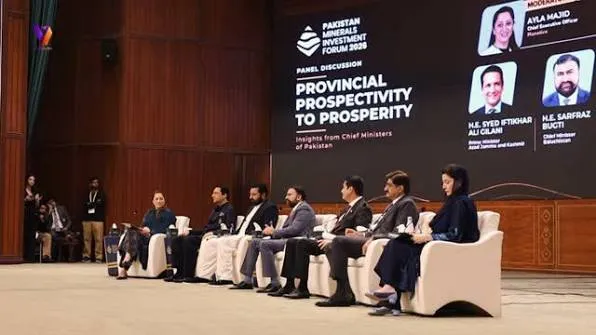
Azad Jammu and Kashmir has placed its mineral resources on the national investment agenda, with Prime Minister Barrister Syed Iftikhar Ali Gillani inviting domestic and international investors to explore the region's largely untapped geological potential. Speaking at the Pakistan Minerals Investment Forum 2026 in Islamabad, the Prime Minister highlighted the region's deposits of precious and semi-precious gemstones, granite and minerals used in industrial production.
The two-day forum, held on November 12–13, brought together government representatives, international investors, mining companies and industry experts from more than 60 countries. Leaders from Pakistan's provinces, AJK and Gilgit-Baltistan presented their respective mineral resources and investment opportunities.
Representing Kashmir, Prime Minister Gillani made a particular appeal to companies with expertise in high-altitude mining. He pointed to the region's challenging mountainous terrain and the need for specialised technical partners capable of conducting exploration and developing mining operations in such conditions.
He also highlighted the AJK government's efforts to align its mining legislation with the regulatory framework being developed across the country. The proposed legislation, he said, had almost reached the AJK Legislative Assembly. Similar regulations and registration procedures would help establish a more uniform investment environment.
The Prime Minister described AJK's peaceful environment as another advantage for investors and assured interested companies of government facilitation. He also explained that applications for mining licences could be submitted through the relevant department, with the Director General responsible for handling investment-related matters.
What Lies Beneath Kashmir's Mountains?
The region's mineral potential extends well beyond the gemstones traditionally associated with its mountainous areas.
According to the Department of Mineral Resources, Government of AJK, Neelum Valley has particularly promising deposits of ruby, tourmaline and topaz. The department's mineral investment brochure identifies a potential gemstone-bearing area exceeding 400 square kilometres in Neelum. It also identifies seven pegmatite formations as potential sources of semi-precious stones.
Nangi Mali in Neelum is among the identified ruby-bearing locations. The government brochure lists an estimated deposit of approximately 39.65 million grams, although the underlying assessment dates back to earlier exploration studies and requires further technical validation.
The potential is not confined to gemstones. Official geological assessments identify granite in Muzaffarabad and Neelum, marble deposits in both districts, and limestone, gypsum and other cement-manufacturing materials around Muzaffarabad. Coal deposits have also been identified in Muzaffarabad and Kotli, while bauxite, bentonite, fireclay, quartzite and graphite feature in the region's mineral inventory.
The government brochure further identifies gold occurrences and rare earth elements in a geological belt covering parts of Neelum, Muzaffarabad and Kahuta. These occurrences have been reported in stream and river sediments. However, their commercial significance requires detailed exploration and resource assessment.
A 2020 research paper by Muhammad Sadiq Malkani, associated with the Geological Survey of Pakistan, also documents AJK's gemstone resources, including ruby, tourmaline, topaz, aquamarine and beryl. It highlights the region's potential for marble, construction materials, industrial minerals and cement-related industries.
From Mineral Deposits to Local Industry
For AJK, the opportunity is not simply about extracting minerals and selling them in domestic or international markets. The greater economic value lies in developing industries around these resources.
Gemstone cutting, polishing, grading, certification and jewellery manufacturing could create opportunities for local businesses and skilled workers. Similarly, processing granite and marble within the region could support construction-related industries, generate employment and reduce dependence on finished materials brought from elsewhere.
The national investment forum also placed considerable emphasis on value addition. Prime Minister Shehbaz Sharif called for moving beyond raw mineral exports towards domestic processing, refining and manufacturing. He stressed that mining investments should generate local employment, develop technical skills and improve public services in communities surrounding mining sites.
These priorities are particularly relevant to AJK, where mineral development could diversify an economy heavily dependent on public-sector employment, services, agriculture and tourism.
The Road Ahead for AJK
Realising this potential will require more than investment invitations. Comprehensive geological mapping, updated resource estimates, feasibility studies, reliable energy supplies, transport infrastructure and transparent licensing procedures will be essential.
Environmental safeguards must also remain central to mining decisions. AJK's mountainous terrain, forests, rivers and settlements require careful planning. Mining operations must protect water resources, maintain worker safety and minimise damage to fragile ecosystems.
The government must also ensure that communities living near mineral deposits receive tangible benefits through employment, skills development, infrastructure and opportunities for local enterprises.
Prime Minister Gillani's participation in the forum has brought AJK's mineral resources into an important national investment discussion. The next challenge is to translate that visibility into scientific exploration, responsible investment and productive industries.
Kashmir's mineral wealth could become an important source of economic opportunity. Its real value, however, will be measured not by the quantity of resources beneath its mountains, but by the prosperity and opportunities created for the people living among them.