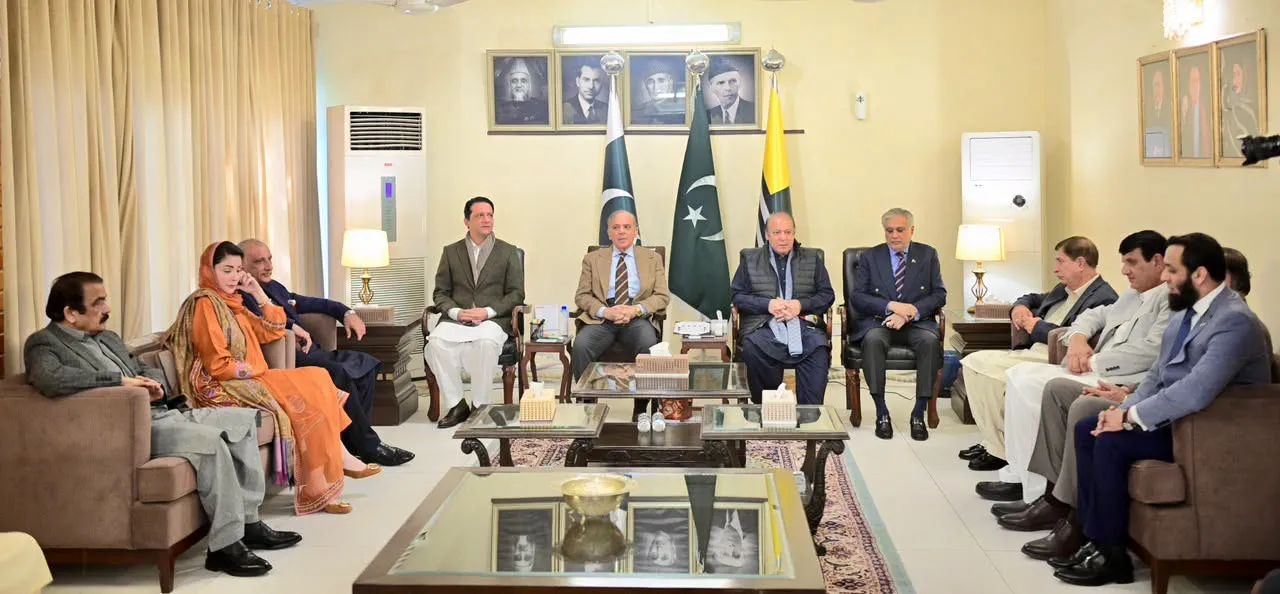
The top leadership of Pakistan Muslim League-Nawaz (PML-N), including party president Nawaz Sharif, Prime Minister Shehbaz Sharif, Punjab Chief Minister Maryam Nawaz and Deputy Prime Minister Ishaq Dar, visited Muzaffarabad on November 18, 2026, to review the Azad Jammu and Kashmir (AJK) government's proposed 100-day development agenda.
The high-level meeting, held at the Prime Minister's House in Muzaffarabad, brought together the federal and AJK leadership to discuss development priorities, funding arrangements and the implementation of the new government's commitments.
Senior PML-N leaders from AJK, including Shah Ghulam Qadir and Raja Farooq Haider, along with members of the AJK cabinet, also attended the meeting.
Addressing the gathering, PML-N President Nawaz Sharif said the AJK government had prepared an ambitious 100-day development plan, which had received approval from the federal government. He assured that the centre would provide the necessary financial resources to implement the proposed initiatives.
Nawaz Sharif also highlighted Punjab Chief Minister Maryam Nawaz's commitment to supporting AJK's development. He recalled her election campaign announcements regarding the introduction of Green Buses and Clinics on Wheels in Muzaffarabad and Mirpur, adding that she was willing to extend further assistance.
Expressing confidence in the AJK government's leadership, Nawaz Sharif said he saw the same passion for public service in Prime Minister Barrister Iftikhar Ali Gillani that he himself had always believed in. He expressed confidence that the present government had both the will and determination to deliver.
He observed that AJK had suffered because of ineffective governance in previous years. However, he described the current political alignment between the AJK government, the PML-N leadership and the federal government as an important opportunity to accelerate development in the region.
Prime Minister Shehbaz Sharif also addressed the meeting, expressing gratitude that the PML-N leadership, under Nawaz Sharif, had once again been entrusted with the opportunity to serve the people of AJK.
He reiterated Pakistan's moral and political support for the people of Indian illegally occupied Jammu and Kashmir (IOK), particularly those facing imprisonment, detention and restrictions. He said Pakistan would continue supporting their struggle for the rights guaranteed under relevant United Nations resolutions.
On development, Shehbaz Sharif assured the AJK government of full federal financial support for its proposed projects. He acknowledged the contributions of Deputy Prime Minister Ishaq Dar, Rana Sanaullah, Ahsan Iqbal, Amir Muqam and Punjab Chief Minister Maryam Nawaz in ensuring the availability of resources for AJK.
The prime minister also announced several initiatives in education and public service delivery. Danish Schools in AJK will receive artificial intelligence and advanced technology laboratories to strengthen the quality of education. These institutions, he said, would provide educational opportunities to children from underserved communities who cannot afford quality schooling.
He also announced that a campus of Danish University would be established in Muzaffarabad. A Khidmat Centre would be set up in the city to facilitate citizens and improve access to public services.
Shehbaz Sharif further announced the completion of a Women Software Technology Park project in AJK, highlighting the importance of expanding opportunities for women in the technology sector.
Speaking at the meeting, AJK Prime Minister Barrister Iftikhar Ali Gillani said a strong and stable Pakistan was an important source of strength for the Kashmiri people's struggle for their rights and freedom.
He observed that frequent changes of government over the previous five years had weakened public confidence in political institutions. His administration, he said, intended to address this trust deficit through visible progress and timely delivery.
Barrister Gillani outlined an extensive programme of initiatives that his government intends to implement within its first 100 days.
In healthcare, the plan includes establishing diagnostic laboratories and stroke centres, introducing Clinics on Wheels, and upgrading Basic Health Units (BHUs). The government also intends to launch the Suthra Kashmir cleanliness programme within the first month.
Under the Apni Chhat Apna Ghar housing initiative, the government plans to expand access to housing opportunities. In tourism, government-owned tourist rest houses will be renovated to improve facilities and promote tourism across the region.
The Green Bus initiative is planned for six cities. In education and youth development, the agenda includes scholarships, skills development programmes and youth business loans.
Infrastructure development will also receive particular attention, with projects planned for Muzaffarabad, Bagh and Mirpur. The government aims to develop urban infrastructure in these cities alongside the introduction of new public transport facilities.
The AJK prime minister said timely implementation of the 100-day agenda would be an important step towards restoring public confidence in government institutions.
He also highlighted the educational infrastructure being developed in AJK, including five Danish Schools and the proposed university. He said these institutions would offer educational standards significantly higher than those available through many conventional private schools.
On regional connectivity, Barrister Gillani said work on the Muzaffarabad-Mansehra Motorway was also progressing. The project would connect AJK with Pakistan's wider motorway network, improving accessibility and creating opportunities for tourism, trade and economic activity.
Punjab Chief Minister Maryam Nawaz also addressed the meeting, appreciating the AJK government's development agenda and its efforts to establish clear priorities for its initial 100 days.
She particularly welcomed the proposed skills development programme, drawing on Punjab's experience with similar initiatives. She said approximately 500,000 students had received training under Punjab's skills development programmes over the previous two and a half years, with many now earning livelihoods locally and internationally.
The November 18 meeting marked an important demonstration of political and administrative coordination between the AJK and federal governments. With financial backing pledged by Islamabad and support promised by Punjab, the focus now shifts to translating the proposed 100-day agenda into tangible improvements in the lives of people across AJK.