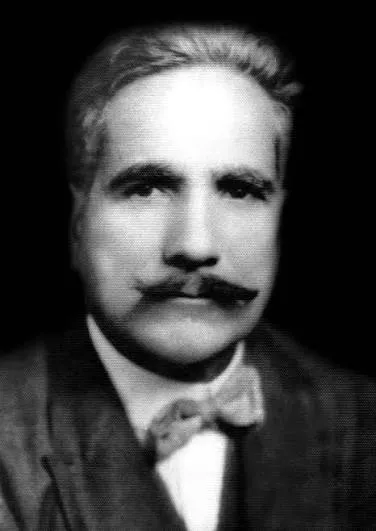
Allama Muhammad Iqbal's relationship with Kashmir was deeper than ancestral nostalgia. It was a connection shaped by family heritage, cultural memory, intellectual engagement and a profound concern for the people of the Valley.
Born in Sialkot on November 9, 1877, Iqbal became one of the most influential poets and philosophers of the modern Muslim world. His writings explored human dignity, selfhood, freedom and the intellectual revival of Muslim societies. Yet, behind much of his philosophical thought was a personal connection to a land he had never regarded as merely a place of ancestral origin.
Kashmir occupied a distinctive place in Iqbal's imagination. He admired its natural beauty, recognised its remarkable literary and artistic traditions, and repeatedly drew attention to the difficult conditions of its people. His poetry moved between admiration for the Valley's cultural inheritance and sorrow over the poverty and political subordination experienced by its inhabitants.
To understand Iqbal's connection with Kashmir is to explore an important intersection of Kashmiri heritage, South Asian intellectual history and Urdu and Persian literature.
A Kashmiri family that found its way to Punjab
Iqbal was born into a family of Kashmiri Muslim descent. His ancestors belonged to the Sapru community, a Kashmiri Brahmin lineage whose members had embraced Islam several generations before his birth.
According to the biographical chronology published by the Allama Iqbal Academy, the family's history can be traced to an ancestor known as Baba Loal Hajj, who embraced Islam in Kashmir during the fifteenth century. His descendant, Sheikh Jalaluddin, eventually migrated to Sialkot with his four sons in the late eighteenth or early nineteenth century. One of them was Sheikh Rafique, Iqbal's grandfather.
The family settled in Punjab, but its Kashmiri origins remained an important part of its identity. Iqbal inherited this connection and took pride in it. His Kashmiri background was not simply a genealogical detail. It became an important element of his literary imagination and his understanding of the region's history.
His father, Sheikh Noor Muhammad, was a deeply religious man. Iqbal grew up in a household shaped by Islamic learning and traditional values. He later developed an intellectual outlook that brought together Islamic philosophy, Persian literature, European thought and the political questions of his time.
Despite being born and educated in Punjab, Iqbal maintained a strong emotional attachment to Kashmir. He regarded it as the ancestral homeland of his family and frequently returned to its landscape and people in his poetry.
His first journey to Kashmir
Iqbal's connection with Kashmir became more personal when he visited the Valley in June and July 1921.
He travelled to Srinagar in connection with a legal case and remained there for approximately two weeks. The journey offered him an opportunity to experience the region beyond its inherited memories and literary descriptions.
The natural landscape made a deep impression on him. The waters of Dal Lake, the surrounding mountains, gardens and changing colours of the Valley found their way into his poetic expression.
However, what he witnessed also disturbed him. Behind Kashmir's extraordinary natural beauty was a population struggling with poverty, limited educational opportunities and an unequal social order.
During this visit, Iqbal composed Persian poetry inspired by Kashmir. His engagement with the Valley also found expression in Payam-e-Mashriq (A Message from the East), published in 1923. One of its notable compositions, Saqi Nama, draws upon the beauty of Srinagar while questioning the condition and self-respect of its people.
This contrast became one of the defining features of Iqbal's writing about Kashmir. He could admire its mountains, gardens and waters while remaining deeply troubled by the circumstances of those who lived among them.
Kashmir's political struggle and Iqbal's advocacy
During Iqbal's lifetime, Kashmir was governed by the Dogra dynasty. The Treaty of Amritsar, signed on March 16, 1846, had transferred control of Kashmir to Maharaja Gulab Singh under an arrangement with the British East India Company for 75 lakh Nanakshahi rupees.
The agreement followed the First Anglo-Sikh War and established a princely state under Gulab Singh. For Iqbal, the arrangement represented a profound historical injustice. The fate of a people and their homeland had been determined through a political transaction in which their own wishes had no meaningful place.
Iqbal's concern extended beyond this historical episode. He was particularly troubled by the economic and social conditions of ordinary Kashmiris, including farmers, artisans and labourers.
The region's handicrafts enjoyed international recognition. Kashmiri shawls and textiles were valued in distant markets. Yet the people responsible for producing these goods often remained impoverished. Iqbal saw this contradiction as an example of a deeply unequal social order.
His engagement with Kashmir was not confined to poetry. He participated in organised efforts to highlight the grievances of Kashmiri Muslims in British India.
He had earlier joined the Kashmiri Muslim Association in Lahore, established in 1896. Later, following the events of 1931, he became an important figure in the All India Kashmir Committee, which was formed to draw attention to the conditions of Kashmiris and support their cause. He subsequently served as its president.
The committee sought to bring Kashmir's grievances to a wider audience. Its work included highlighting political and civil rights, supporting public awareness and drawing attention to the treatment of the population under the princely administration.
Iqbal's involvement reflected a conviction that Kashmir's problems deserved attention beyond the geographical boundaries of the Valley.
Kashmir in the poetry of Iqbal
Kashmir appears in Iqbal's poetry in two closely connected forms. It is a land of extraordinary natural beauty and a society whose people have been denied the dignity and prosperity they deserve.
He frequently used expressions such as Iran-e-Sagheer (Little Iran), Jannat-e-Kashmir (Paradise of Kashmir) and Khitta-e-Gul (Land of Flowers). These descriptions reflected his admiration for the Valley's landscape and its Persian-influenced literary and cultural heritage.
Kashmir's intellectual history was also important to him. He referred to celebrated Kashmiri figures, including the Persian poet Ghani Kashmiri and the Sufi scholar Mir Sayyid Ali Hamadani, whose influence on the region's religious, literary and cultural traditions remains significant.
But perhaps Iqbal's most powerful reflections on Kashmir came when he turned his attention to its people.
In Javid Nama, his Persian philosophical poem published in 1932, Iqbal revisited Kashmir's historical loss of freedom through the imagined voice of Ghani Kashmiri. The poem draws a connection between the region's historical experience and the political conditions of Iqbal's own time.
In one particularly striking passage, the poet invokes the League of Nations and condemns the historical transaction through which Kashmir had been transferred to Gulab Singh.
The imagery is powerful. Fields, rivers, gardens and an entire population become part of a political bargain. Iqbal's criticism is not simply directed at the monetary value of the transaction. It is directed at the principle that a people's homeland could be treated as property without their consent.
His poetry therefore transformed a historical event into a broader question of human dignity and political justice.
The lament of a once-prosperous Valley
One of Iqbal's most memorable poems about Kashmir appears in Armaghan-e-Hijaz, his final collection, published posthumously in 1938.
It opens with the famous couplet:
آج وہ کشمیر ہے محکوم و مجبور و فقیر کل جسے اہل نظر کہتے تھے ایران صغیر
Today Kashmir is subjugated, helpless and impoverished, the land that once the wise and learned called Little Iran.
The couplet captures the central contradiction in Iqbal's understanding of Kashmir. A region celebrated for its intellectual achievements, craftsmanship and natural wealth had become a place of hardship and political subordination.
He continues:
کہہ رہا ہے داستاں بیدردی ایام کی کوہ کے دامن میں وہ غم خانہ دہقان پیر
The imagery of an ageing peasant's sorrowful home beneath the mountains brings the suffering of ordinary Kashmiris into focus.
The farmer becomes a representative of an entire population. His poverty tells a story that official accounts of prosperity and natural beauty cannot capture.
Iqbal was particularly sensitive to the position of Kashmiri artisans. They produced objects admired across the world, yet their own lives were often marked by deprivation. His criticism was directed at a system in which the rewards of labour accumulated elsewhere while the workers remained poor.
This was consistent with a wider theme in his philosophy: human beings should not be reduced to instruments of economic or political power. They must possess dignity, agency and the ability to shape their own lives.
The imagined voice of Zaigham Lolabi
Another fascinating feature of Armaghan-e-Hijaz is the section titled Mulla Zada Zaigham Lolabi Kashmiri Ka Bayaz (The Notebook of Mullah Zada Zaigham Lolabi Kashmiri).
The name Lolabi refers to Lolab, a valley in the Kupwara region of Kashmir. Through this literary figure, Iqbal brings a distinctly Kashmiri voice into his final collection.
One of the poems in this section begins:
پانی ترے چشموں کا تڑپتا ہوا سیماب
The opening image evokes the restless, living waters of Kashmir's springs. It is an expression of the Valley's natural character, but the wider section also carries Iqbal's concerns about freedom, identity and the condition of its people.
The inclusion of this imagined Kashmiri figure is significant. Iqbal was not simply writing about Kashmir from a distance. He was giving its landscape, history and people a place within a much larger philosophical conversation about human freedom and selfhood.
The enduring relevance of Iqbal's message
Iqbal died in Lahore on April 21, 1938, but his intellectual and literary relationship with Kashmir continued to influence how generations understood the region's cultural identity.
His connection with Kashmir was rooted in ancestry, but it developed into something much broader. He recognised its contribution to the intellectual and artistic heritage of the subcontinent. He admired its natural beauty, studied its literary traditions and expressed concern for the people whose labour and resources sustained its economy.
Perhaps the most important aspect of his relationship with Kashmir was that he refused to view the Valley merely as a beautiful geographical region. For him, its people mattered as much as its mountains, rivers and gardens.
His philosophy of Khudi, commonly understood as selfhood or the development of a strong and conscious individual identity, offers another way to understand his writings on Kashmir. He believed that individuals and communities needed intellectual confidence, self-respect and the courage to shape their own futures.
For Kashmir, this message carries an enduring cultural significance. The region's history is not defined by its landscape alone. Its literature, craftsmanship, scholarship, traditions and people form an equally important part of its inheritance.
Iqbal's poetry reminds readers of that inheritance. It also reminds them that cultural greatness cannot be measured by the beauty of a land or the fame of its artistic traditions while the people who sustain them remain deprived.
His Kashmir was both a memory of an ancestral homeland and a vision of what a dignified, educated and self-respecting society could become.
That is perhaps why, decades after his death, his words about Kashmir continue to resonate. He saw the Valley not only for what it had been, but also for what its people deserved to become.